Example Insurers
A broker never works with just one insurer. So that the interplay of a broker and several insurers can be demonstrated and tested, the project knows three fictitious example insurers. Each is a persona with its own character, its own product catalogue in its own namespace and its own tariff – and each runs as its own instance of the sample insurer.
The catalogues of the example insurers are informative: illustrations and test data of the reference
implementations, not part of the standard. Normative are only the vocabulary of the product knowledge and its
validation rules (Product Tree and Instance Tree). To understand the standard, the small
sample catalogue of the standard (ex:) is enough; it
belongs to none of the three example insurers.
|
The Three Personas
| Example insurer | Character |
|---|---|
Disrupto Digital Risk Ventures European SE |
Fictitious hypergrowth insurtech. Reinvents its products every minute, tests features in production and has the fastest tariff of the three. The first and most complete catalogue; template for the other two. |
Anglo-American a. G. founded 1859 |
Fictitious incumbent with a long tradition and grown system landscapes. Thorough, conservative, connects innovations of the standard pragmatically through a wrapper. Most expensive tariff. |
Pfefferminzia Versicherungs-AG |
Fictitious mid-sized composite insurer – the typical case in the market: neither insurtech nor incumbent, solid products, cheapest tariff. |
Today the three differ only in catalogue, name, namespace and tariff; their motor products have the same structure: Disrupto carries the tariffs GoFlux 2020 to 2022 and two life products, Anglo-American exactly one product "Automobilversicherung 2026" and Pfefferminzia exactly one product "Pfefferminzia Kraftfahrt 2025". The differences the personas are meant for – product styles, process variants such as "no draft at the server" or "calculation as an inquiry without a business case", a reference wrapper at Anglo-American – come with the next steps of the project (Approach and Artefacts). With the further business case types – contract change, conversion, claim notification – every example insurer declares variants of its own per type, such as which derivations and transitions it offers and whether it holds drafts (Business Case Types).
Namespaces and Catalogues
Every example insurer has its own namespace below https://vvo.at/omds/ld/example/; products and components lie
entirely within it and refer only to the normative vocabulary, never to another example catalogue.
| Example insurer | Prefix | Namespace | Catalogue in the repository |
|---|---|---|---|
Disrupto |
|
|
|
Anglo-American |
|
|
|
Pfefferminzia |
|
|
The catalogues lie in the data module reference/example-insurers next to the reference implementations, not in
the standard: they may grow with further insurers and variants without changing the standard. Every catalogue
consists of files for general definitions, motor, where applicable life, and the process knowledge (the declaration
per business case type, today only for the application process), and starts with a header naming the insurer, the publisher, the date and the note "informative, not part of the standard". The same
tests with which the standard checks its sample catalogue run in the data module against every catalogue: against the
validation rules of the standard and that it stays within its namespace. Every catalogue comes with a motor example
instance.
One Instance per Insurer
A running sample insurer is exactly one example insurer: it loads only that insurer’s catalogue, calculates with its tariff and names it on its info page. Three insurers means three instances – locally on three ports, on the example server as three containers behind one entry point (Installation & Setup Server).
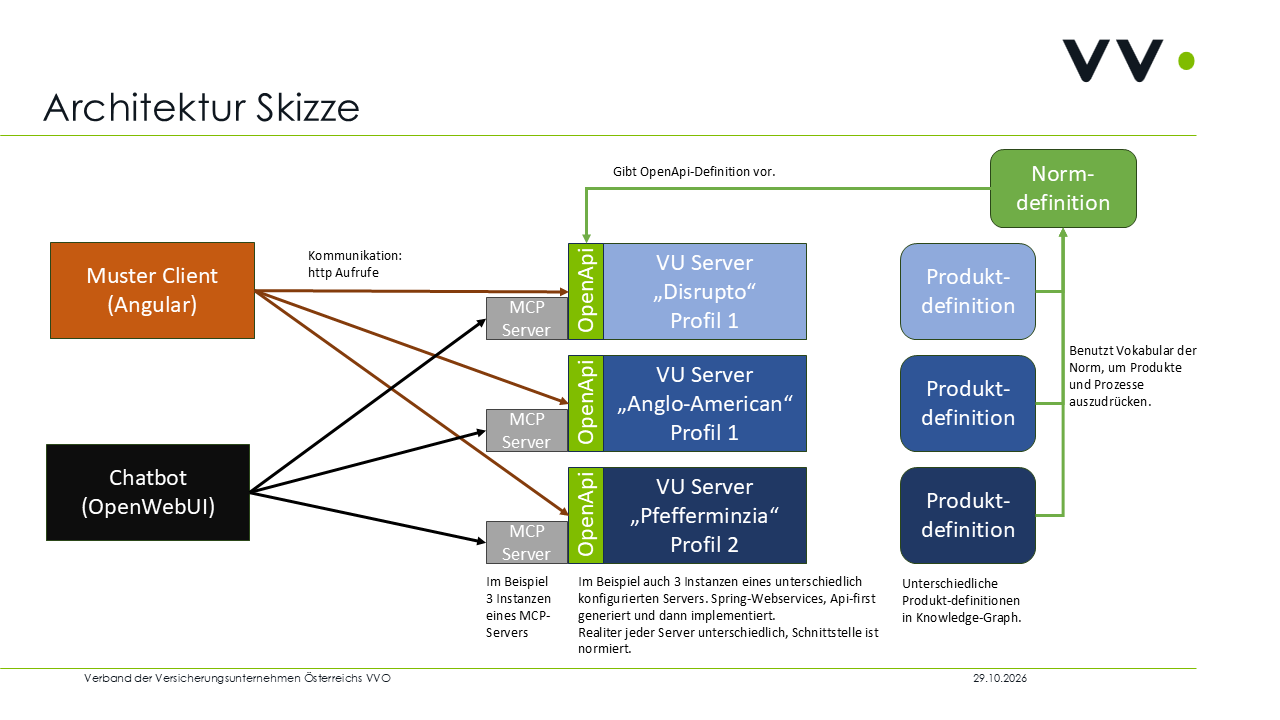
The boxes of the sketch are linked: the sample broker and the chatbot lead to the running application, the OpenAPI boxes to the API explorer and each product definition to the product tree of its motor product. The sample broker and the chatbot are clients. The sample broker calls the interface of each insurer directly, the chatbot through the MCP server of the insurer concerned – three times the same software in front of a different interface (AI agents (MCP)). The three sample insurers are the same software as well, configured differently: Disrupto and Anglo-American calculate through the tariff inquiry, Pfefferminzia holds the draft at the server. The standard definition prescribes the OpenAPI file and the vocabulary; each product definition uses it to express the insurer’s products as a knowledge graph. In practice every insurer’s server is software of its own; only the interface is standardised.
| Example insurer | example server (entry point) | example server (direct) |
|---|---|---|
Disrupto |
https://kapdion.com/omds-ld/insurers/disrupto/api (alias https://kapdion.com/omds-ld/api) |
port |
Anglo-American |
port |
|
Pfefferminzia |
port |
A business case id is only valid at the instance that issued it – just as an application only exists at the insurer it was submitted to.
Tariff and Calculation Methods
How a premium comes about is not prescribed by the standard – that remains the insurer’s business (calculation). In the sample insurer, the tariff of an example insurer is therefore the insurer’s code, and it assigns every product of its catalogue a calculation method: motor products are calculated with the liability/casco formula, life insurances with a life formula of their own. The inputs a method needs are declared by the catalogue as attributes (motor: the sum insured of the liability; life: sum insured, term and entry age at the sales product), so that a broker or AI agent can supply them. A product the tariff assigns no method to receives a message instead of a premium when calculated.
| Example insurer | Product | Calculation method |
|---|---|---|
Disrupto |
GoFlux 2020, GoFlux 2021, GoFlux 2022 |
motor |
Disrupto |
Premium Lebensversicherung Tarif 2024, Disrupto Premium Lebensversicherung 2026 |
life |
Anglo-American |
Automobilversicherung 2026 |
motor |
Pfefferminzia |
Pfefferminzia Kraftfahrt 2025 |
motor |
The formulas are example figures without actuarial claim; today the three tariffs differ by a constant factor on the premium (Disrupto 1.00, Anglo-American 1.15, Pfefferminzia 0.90).
Vehicle Templates
Every example insurer has vehicle templates in its catalogue for the vehicle form (Vehicle templates of the insurer): five common brands each with three to five types, with power and list price. The catalogues differ because this is knowledge of the insurer – Disrupto offers mostly electric vehicles, Anglo-American classics and the upper class, Pfefferminzia the average. Power and prices are fictitious sample data and not accurate to the market.
In the Sample Broker
The sample broker knows the three example insurers as the defaults of its insurer list and asks all active insurers at once during product selection. On the page "Versicherer" (insurers) insurers can be deactivated, checked for reachability and further ones added – external ones too, as long as they offer the services (Installation & Setup Client).